

AI Search Rankings: What They Really Mean
Ask ten people what "ranking #1 in AI search" means, and most will picture something like a Google results page: a numbered list, your site somewhere on it, a position you can track going up or down. That's not how it works.
AI engines like ChatGPT and Google's AI Overviews don't return a ranked list of links. They generate an answer and decide which sources, if any, to mention or cite while writing it. There's no slot #1 to fight for, because there's no list to begin with.
This doesn't mean "ranking" is a meaningless idea in AI search, it means it measures something different: whether you get cited at all, how often, and how you stack up against other domains competing for the same topic. Below, we walk through what a real AI search ranking actually looks like, using a live domain as the example, and where the idea of a numbered position genuinely does exist in this product versus where it doesn't.

What Are AI Search Rankings, Really?
In classic search, ranking means position: your page is #1, #7, or #34 for a given query, and Google shows you exactly where. AI search rankings, sometimes searched as AI search engine ranking, work on a different logic, because AI engines don't produce a list of positions in the first place.
When someone asks ChatGPT or Google's AI Overviews a question, the engine generates a written answer and decides, source by source, whether to mention a brand or cite a domain while writing it. There's no fixed set of results to be ranked within, there's a generated answer, and you're either part of it or you're not.
In practice, this reframes what "ranking" has to measure:
- Whether you're mentioned or cited at all, for a given topic
- How often, across the range of questions people actually ask about that topic
- How you compare to other domains also being cited on the same topic
| Traditional Search | AI Search | |
|---|---|---|
| Structure | A list of positioned results | A single generated answer |
| What "Ranking" Means | A numbered position, like #1 or #7 | Being cited or mentioned, and how often |
| How It Changes | Tracked as a position moving up or down over time | Tracked as citation share among domains competing for the same topic |
Why There Is No "Position #1" Across Every AI Engine At Once
It's tempting to look for a single "AI ranking" the same way you'd check a Google position: one number, one platform, done. That number doesn't exist, for a structural reason: ChatGPT and Google's AI Overviews are separate systems, each generating their own answers from their own selection process. A brand can be cited heavily in one and completely absent from the other, for the exact same question.
A real AI ranking check is always measured one platform at a time, not as a single blended score across every AI engine simultaneously. A tool that claims to give you one unified "AI rank" across all engines at once is usually collapsing several different measurements into a number that looks simpler than what's actually happening underneath. It's also the gap behind searches for AI Overview rank tracking specifically: people looking for a tracker built for Google's AI Overview alone, when the more useful check is a citation ranking measured directly on that one platform, not a blended cross-engine guess.
How to Check Your AI Search Ranking
The most direct way to check where a domain stands is to run it through a tool that ranks domains by how often they're cited on a given topic, not just a single score in isolation. Here's what that looks like with a real domain, not a mockup.
Searching Kolorii's domain (a personal coloring-pages site, used throughout this guide as a real, verifiable example) on ChatGPT for the coloring-pages topic returned a real position: kolorii.com ranked #1 of 13 domains found, with 5 citations and a 21.7% citation share.
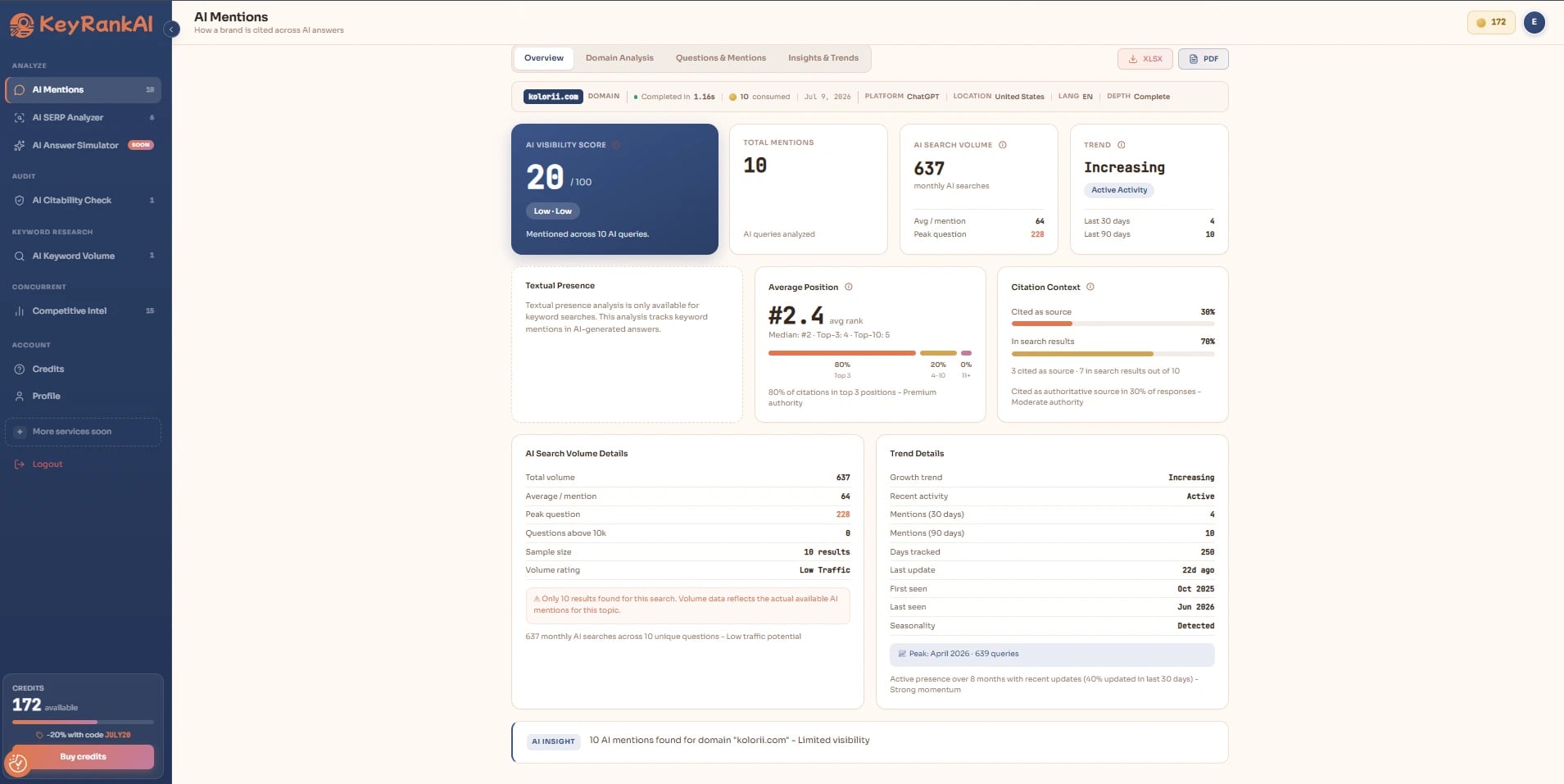
This #1 position means something specific: among the 13 domains AI engines actually cited when answering questions about that topic on ChatGPT, this one was cited the most often. Rerunning the exact same check on Google's AI Overviews could produce a different rank entirely, since it's a separate system with its own source selection. That's the "one platform at a time" point from earlier, made concrete.
Keyrankai's AI Mentions is what produced this ranking.
What Actually Improves Your AI Search Ranking
This is the practical answer to how to rank in AI search results: since AI ranking comes down to citation share on a topic, improving it means giving AI engines more reasons to recognize and cite a domain specifically, not generic SEO advice recycled for a new context.
Get Recognized as a Distinct Entity
Before an AI engine can cite a brand, it has to recognize it as a real, distinct thing, not a string of words. Clear, consistent naming across a site, plus content that explicitly states what the brand is and does, makes that recognition easier.
Show Up in the Text, Not Just the Metadata
A brand mentioned by name in the body of a page is more likely to end up mentioned by name in an AI-generated answer than one that only appears in a logo or a title tag. AI engines generate answers from text they can read and quote.
Earn Citations on the Specific Topic You Want to Rank For
Domain ranking is topic-specific: a domain that ranks #1 for one topic can rank last, or not appear at all, for a different one. Publishing genuinely useful, specific content on the exact topic matters more than broad authority alone.
Where Real Competitive Ranking Exists
Domain ranking (the section above) tells you how a domain stacks up against every other domain being cited broadly on a topic. Sometimes the real question is narrower: how do you compare to two or three specific competitors you already know by name? That's a different measurement, and a different tool.
Keyrankai's Competitive Intelligence is built for that comparison directly: a positioning score and share of voice measured against named competitors you choose, not the whole market. Run on Kolorii against two real competitors in the coloring-pages space (anonymized here as Competitor A/B), it returned a very different picture than the domain ranking above: last of three brands, 0% share of voice, in a market rated as moderately concentrated.
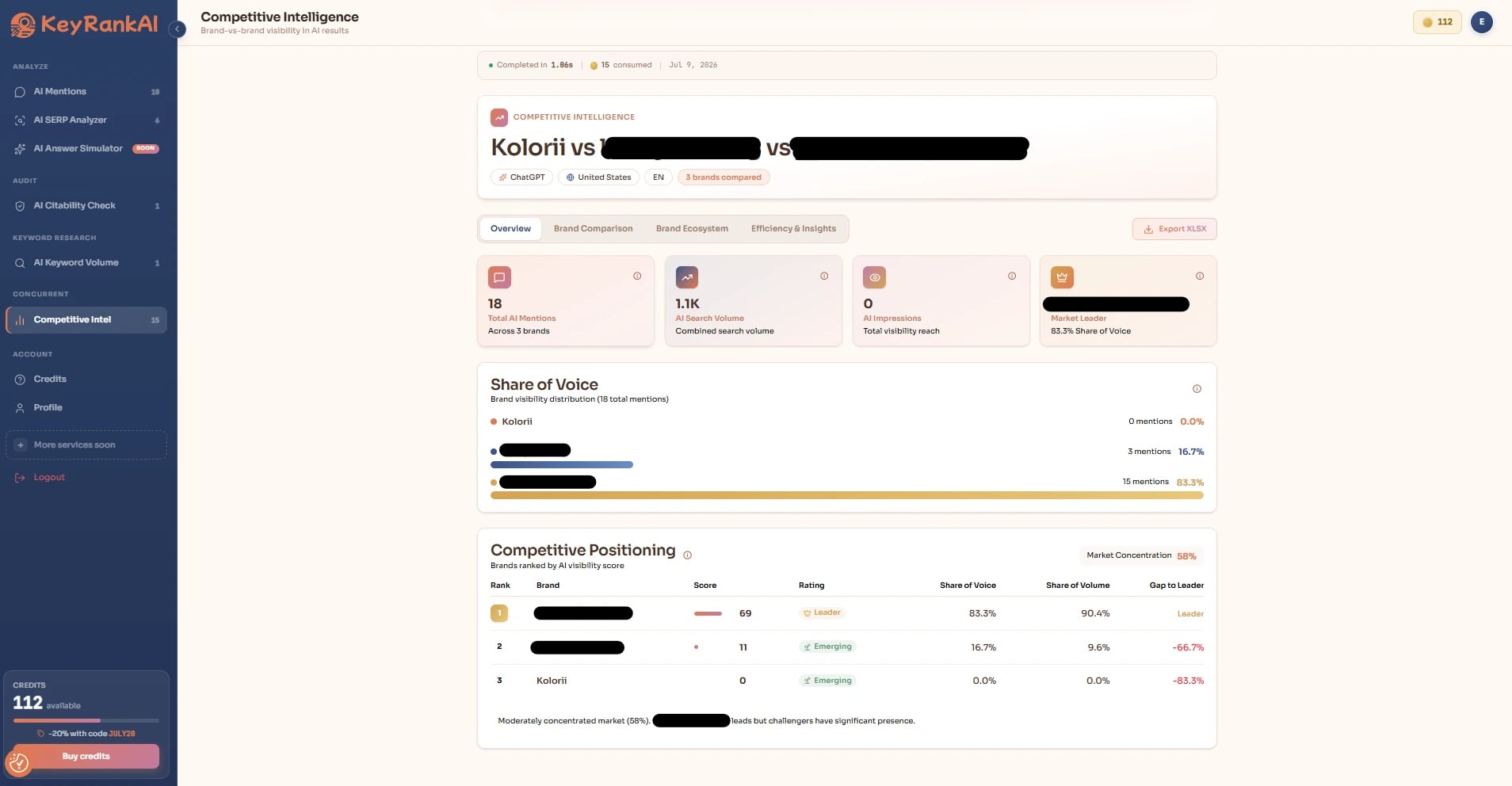
Both results are accurate for the same brand at the same time, because they rank against different things: one against every domain cited broadly on a topic, the other against a specific, hand-picked set of rivals.
What to Look for in an AI Ranking Tool
Not every tool that uses the word "ranking" is measuring the same thing. Before relying on one, check for a few specifics:
- Does it separate citation from position? A tool that talks about "ranking #1" without explaining what that number is actually counting is worth a second look.
- Is the ranking scoped to one platform, clearly labeled? As covered above, a real ranking is measured per AI engine. If a tool shows one blended score across every platform without saying how it's combined, ask how.
- Does it distinguish broad-topic ranking from named-competitor comparison? These answer different questions, as shown in the two tests above, and a tool that only offers one is only giving half the picture.
- Can you verify the underlying data, not just the final score? A ranking is only as trustworthy as the citation data behind it, look for a tool that shows its work.
AI Search Rankings vs Traditional SEO Rankings
| Traditional SEO | AI Search | |
|---|---|---|
| Unit Ranked | A page, for a specific keyword | A domain, for a topic |
| Position Format | A numbered position (#1-100+) | Citation share among cited domains |
| Update Frequency | Recrawled and reranked continuously | Re-measured per check, one platform at a time |
| Tracking Tool | Search Console, rank trackers | AI Mentions, Competitive Intelligence |
The two aren't competing measurements of the same thing, they're measuring different things about the same domain. Keyword volume data for the topics behind an AI ranking check is a useful complement: it shows how much real demand exists behind the queries a domain is (or isn't) being cited for.
Conclusion
AI search rankings measure something real, just not what the word "ranking" usually implies. There's no numbered position to chase across every AI engine at once, there's citation share on a specific topic, measured one platform at a time, and it's a different question from how you compare to competitors you already know by name.
Check both, on a real domain, and you'll likely find they tell two different stories, the same way they did for Kolorii here: a strong #1 position in broad domain citations, and a weak position against named rivals in the same space. Neither is wrong. They're just answering different questions.
Check Your AI Search Ranking
See where your domain actually stands in AI-generated answers, ranked against every domain cited on your topic.
Check Your Ranking