

What Is AEO (Answer Engine Optimization)?
Someone asks ChatGPT or Perplexity a question in your industry. The answer comes back with two or three sources mentioned by name. None of them is you.
That's the moment "AEO" stops being an acronym and starts being a real problem. Answer Engine Optimization is the practice of making sure that, when it happens, you're one of the names in that answer. Below is a clear definition, how it actually differs from SEO and GEO, why it matters more than it looks like from the outside, and how to check today whether you already show up or not.

AEO, Defined Simply
AEO, Answer Engine Optimization, is the practice of optimizing content so it gets cited or mentioned by AI systems that generate direct answers instead of returning a list of links. The goal isn't a position in a results page. It's being one of the sources an AI engine picks when it writes its answer.
Answer Engines, in Practice
"Answer engine" isn't an abstract category. It covers the specific systems people actually use to get a direct answer instead of a list of links: ChatGPT, Perplexity, Google's AI Overviews, Gemini, Copilot. Each one generates its own answer from its own selection of sources, which is why AEO has to be checked per engine, not assumed to work the same way everywhere.
How an Answer Engine Decides What to Cite
An answer engine doesn't crawl a results page and pick the top ten. It retrieves content it judges relevant and trustworthy for the question asked, then writes an answer, choosing along the way which sources to name or link. Content that states things clearly, backs them with verifiable facts, and is easy to extract from a page has a real advantage in that selection, regardless of how well that same page ranks on Google.
AEO vs SEO vs GEO: What Actually Changes
These three terms get thrown around together so often that it's easy to assume they're the same thing with different names. They're not. Each one answers a different question about the same content.
SEO: Getting Found
Search Engine Optimization is about ranking a page in a list of results for a given query, so a person clicks through to the site.
GEO: Getting Understood and Reused by Generative Engines
Generative Engine Optimization is broader: making content easy for generative AI systems to parse, summarize, and reuse when they synthesize an answer from multiple sources.
AEO: Getting Cited as the Answer
Answer Engine Optimization is narrower and more specific: being the source actually named when an AI engine writes its answer to a direct question. It's the outcome GEO practices are usually trying to produce, measured directly instead of assumed.
SEO vs GEO vs AEO
| SEO | GEO | AEO | |
|---|---|---|---|
| Goal | Rank in a list of results | Be understood and reused by generative AI | Be the source cited in a direct answer |
| Success Metric | Position, click-through rate | Inclusion in AI-synthesized answers | Citation frequency, by engine |
| Target System | Search engines (Google, Bing) | Generative AI systems broadly | Answer engines (ChatGPT, Perplexity, AI Overviews) |
| Typical Action | Keywords, backlinks, technical SEO | Clear structure, semantic clarity | Direct answers, verifiable facts, brand clarity |
The three aren't competing strategies. A page can rank well on Google, get reused inside a generative summary, and still never be the one name an AI engine actually cites when someone asks a direct question in that topic. Each one is worth checking on its own terms.
Why AEO Actually Matters Right Now
What's Already Changing in How People Search
More questions now get answered directly inside ChatGPT, Perplexity, or an AI Overview, without a click to any website at all. That doesn't make traditional search irrelevant, but it does mean a growing share of the moment where someone forms an opinion about a brand or a product happens inside an answer you may never see, and never control unless you know whether you're part of it.
The Visibility Loss You Can't See
A ranking drop on Google shows up somewhere: a dashboard, a graph, a client email. Not being cited in AI answers doesn't show up anywhere by default. Nothing breaks, no alert fires, the site keeps running exactly as before. The absence is invisible until someone deliberately checks for it, which is exactly why most sites that have a real AEO problem don't know it yet.
What This Means If You Sell SEO or GEO Audits
For a consultant or an agency, this is a new, largely unclaimed offer. Most competitors are still selling audits built entirely around Google rankings. Being able to show a client, concretely, whether their brand is or isn't cited when AI engines answer questions in their space is a distinct, demonstrable deliverable that most of the market isn't providing yet.
How to Know Where You Stand in AEO (and Improve It)
Start With One Honest Question
Before anything else: is your brand, your domain, or your topic already being mentioned by AI engines today, for the questions that matter to your business? Most people assume the answer without ever actually checking it.
Check Your Current AI Mentions
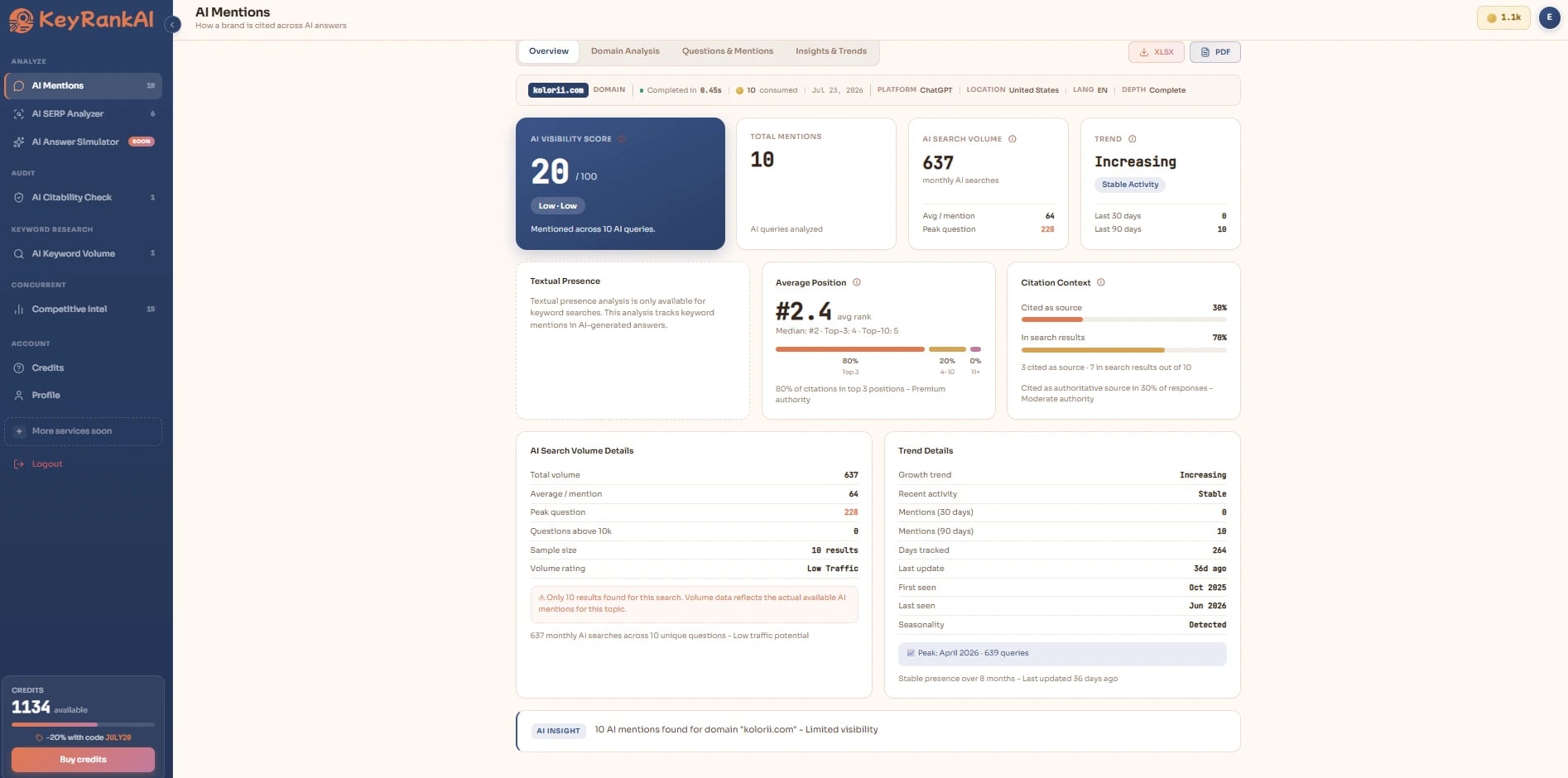
The most direct way to answer that question is to search a brand, a domain, or a topic and see whether ChatGPT and Google AI Overview are already talking about it. Keyrankai's AI Mentions returns an AI Visibility Score out of 100, then breaks down why: Average Position shows how a domain ranks among every citation found for that topic, Citation Context separates being cited "as a source" from just showing up "in results," and Textual Presence shows the share of AI answers that mention the brand by name at all. Total mention count and AI search volume for the topic come alongside it, so a score is never just a number without context.
Go Deeper: See the Real AI Answer on Your Target Keywords
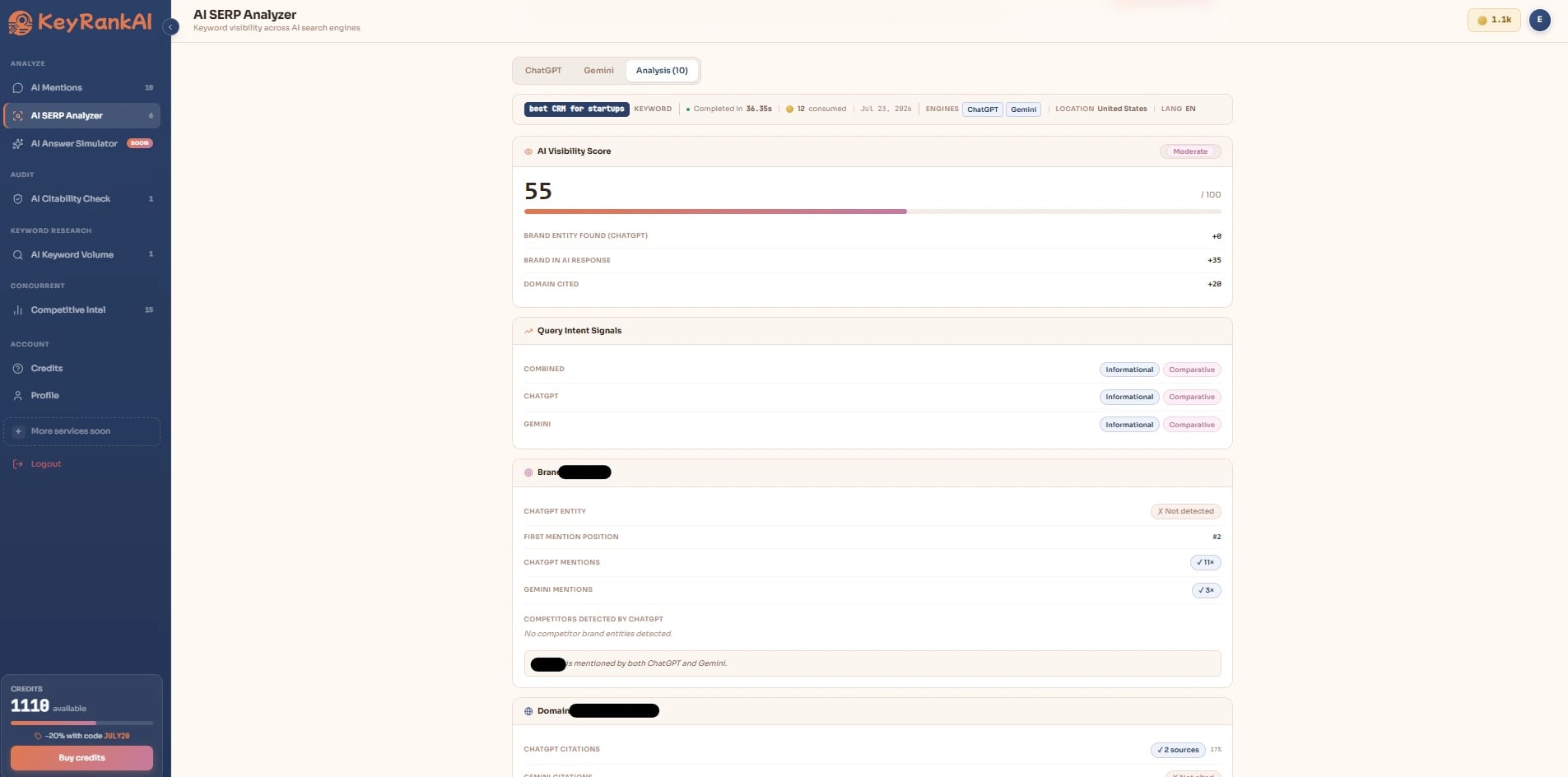
Once you know whether you're mentioned in general, the next question is more specific: for a given keyword, what does ChatGPT or Gemini actually answer right now, and are you one of the sources cited in it? Keyrankai's AI SERP Analyzer pulls the full, real answer generated for that keyword, on each engine. It's a separate check from the AI Visibility Score above: instead of a general score across many mentions, it gives a keyword-specific AI Visibility Score built from concrete signals: whether the brand is recognized as an entity, whether it's mentioned in the answer text, and whether the domain is actually cited for that exact keyword.
The most useful signal here is what it calls the Citation Gap: cases where an AI engine visited a page on the target domain while researching the answer, but chose not to cite it. That's a very different problem from not being seen at all, and it points to a specific, fixable issue with how the content is written, not a visibility problem.
Concrete Levers to Improve Your AEO
- Answer the question directly, early. Structure content so the direct answer to the question a reader is asking appears clearly, not buried after several paragraphs of context.
- Make your brand readable, not just visible. A brand name that only appears in a logo or a meta tag isn't something an AI engine can quote. State who you are and what you do in plain text.
- Back claims with facts an engine can verify. Specific numbers, dates, and named examples are easier for an AI system to trust and repeat than general claims.
- Go deep on the exact topic you want to be cited for. Being cited is topic-specific: broad authority on unrelated subjects doesn't transfer.
Conclusion
AEO isn't a rebrand of SEO or a vaguer version of GEO. It's a specific, checkable question: when an AI engine answers a question in your space, are you one of the names it cites. Right now, most brands don't know the answer for their own domain. Checking it directly, on your actual domain, is the only way to find out for sure.
Check Your AEO Right Now
See whether your brand, domain, or topic is already mentioned by AI engines, and where you stand.
Check Your AI Mentions