

AI Search Visibility: How to Track, Score & Improve It
Ask ChatGPT or Gemini about your brand, and you'll learn something traditional SEO tools can't tell you: whether you actually get mentioned at all.
That's the core of AI search visibility, and checking it is simpler than most guides make it sound. The fastest way to run an AI search visibility audit is to search your brand name (or your domain) through an AI mention tracking tool and see how often, where, and in what context AI engines like ChatGPT and Gemini reference you.
We ran that exact check for this guide, not a hypothetical example, and it produced two very different results depending on the angle: strong domain citations on one side, and a near-invisible brand mention score on the other. Below, we walk through exactly what a real AI Visibility Score measures, why those two numbers can diverge on the same site, and how to move from a one-off check to real tracking.
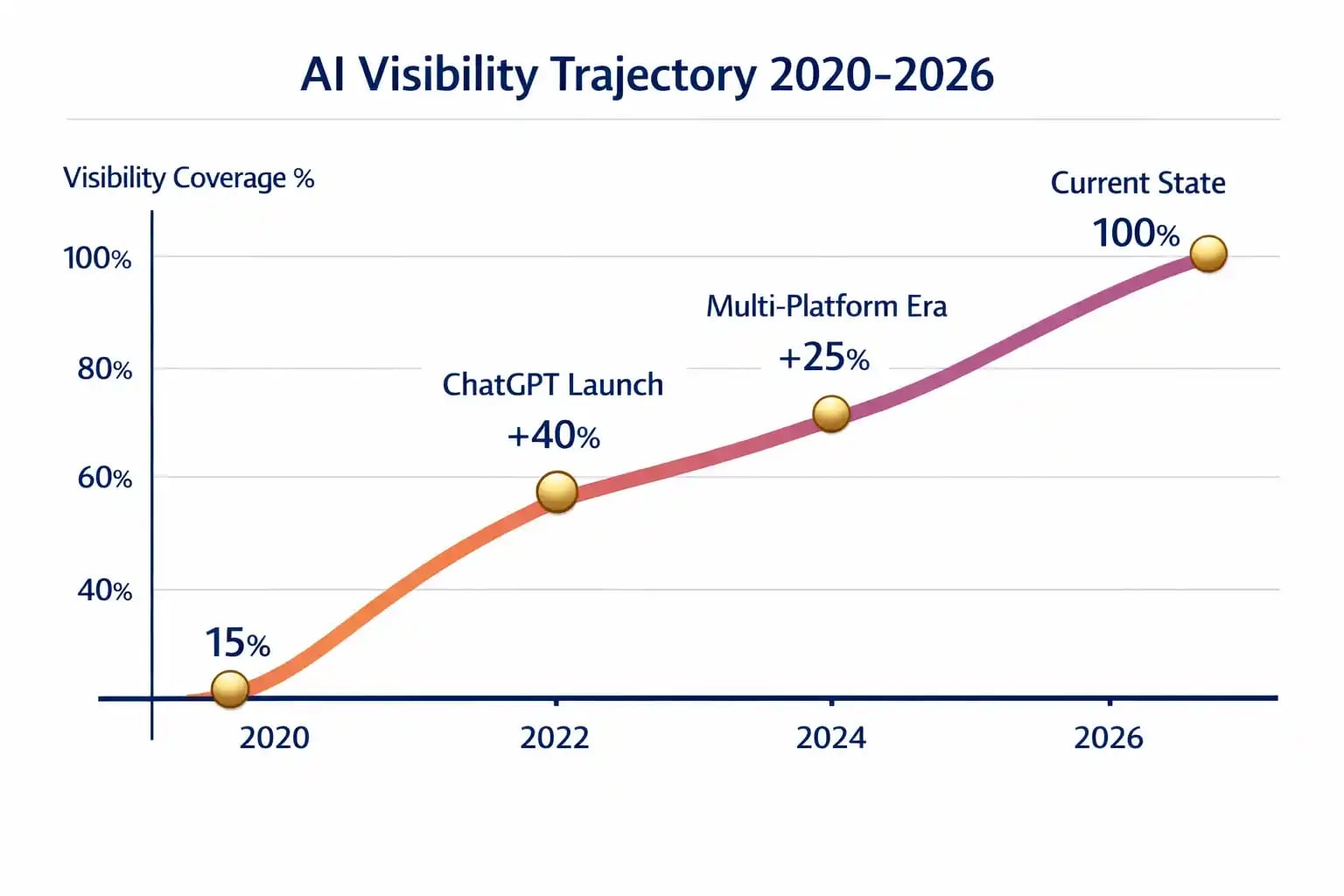
What Is AI Search Visibility?
AI search visibility is a specific form of search engine visibility tracking: how often, and in what way, your brand or website shows up in the answers generated by AI systems (ChatGPT, Gemini, and similar tools) when someone asks a question related to your industry, product, or brand.
It's not the same as being indexed by Google. A page can rank on page one of classic search results and still never get mentioned when someone asks an AI assistant a related question, because AI engines don't just retrieve pages, they generate an answer and decide which sources, if any, to cite or mention by name.
In practice, AI search visibility breaks down into three signals that don't always move together:
- Brand or keyword mentions: does the AI say your name at all, even without a link?
- Domain citations: is your website listed as a source the AI pulled information from?
- Competitive share of voice: how often are you mentioned relative to other brands answering the same kind of question?
We'll walk through how to check each of these below.
Why AI Search Visibility Matters
Being visible in AI-generated answers puts your brand in front of people at the exact moment they're asking a question your product or content can answer, often before they ever open a traditional search results page. If an AI assistant never mentions you, you don't just lose a click, you lose the chance to be considered at all.
| Traditional SEO | AI-Driven Visibility | |
|---|---|---|
| Focus | Keyword ranking | User experience and content relevance |
| Impact | Limited to search engine results | Influences consumer perception and trust across multiple platforms |
| Strategy | Keyword optimization | Content quality, user engagement, semantic optimization |
Being cited or mentioned consistently, not just once, is what actually builds trust with an AI system over time. AI search visibility doesn't replace traditional SEO, it adds a signal that classic rank tracking was never built to measure.
How to Track AI Search Visibility
The most direct way to answer "how do I track AI search visibility" is to run a real search on a brand or domain through an AI mention tracking tool and look at four things together, not just one:
- Visibility score: a single number summarizing how strongly a brand or domain is recognized across AI-generated answers
- Total mentions: how many times, out of the queries actually tested, the brand or domain showed up at all
- Citation position: when a domain is cited as a source, where it ranks among the other sources cited in the same answers
- Trend over time: whether mentions are increasing, stable, or dropping across recent months, since AI visibility isn't a fixed number
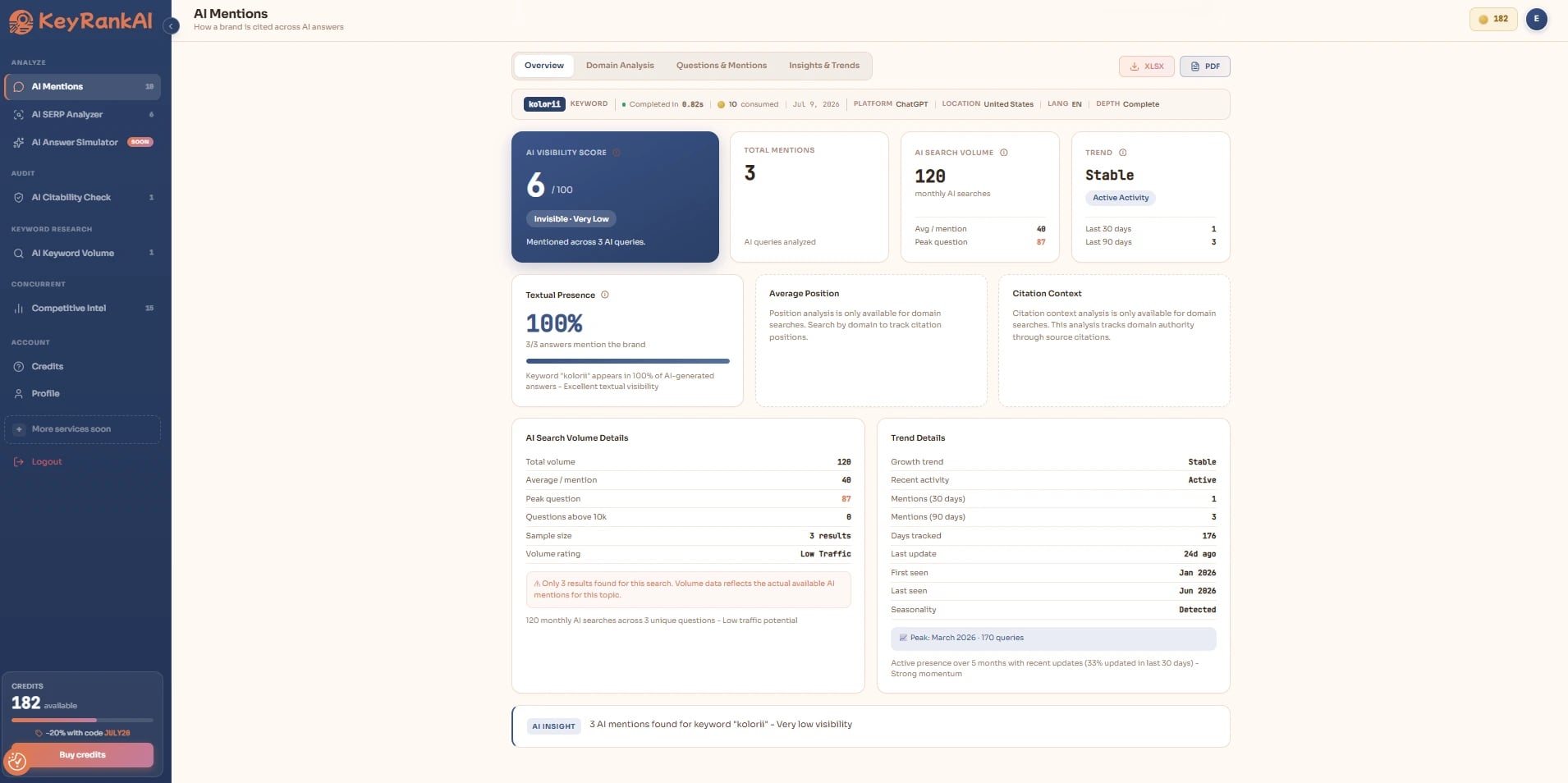
Here's what that looks like with a real search, not a mockup. Searching by brand name (keyword mode) returned a visibility score of 6/100, "Invisible, Very Low", across 3 total mentions found, with a search volume of 120 AI queries per month on the topic and a stable trend:
Searching by brand name only tells part of the story. Running the exact same check in domain mode surfaced a different picture entirely: a visibility score of 20/100, 10 total mentions, an average citation position of #2.4 with 80% of citations landing in the top 3 sources, and a trend marked as increasing over the last 90 days:
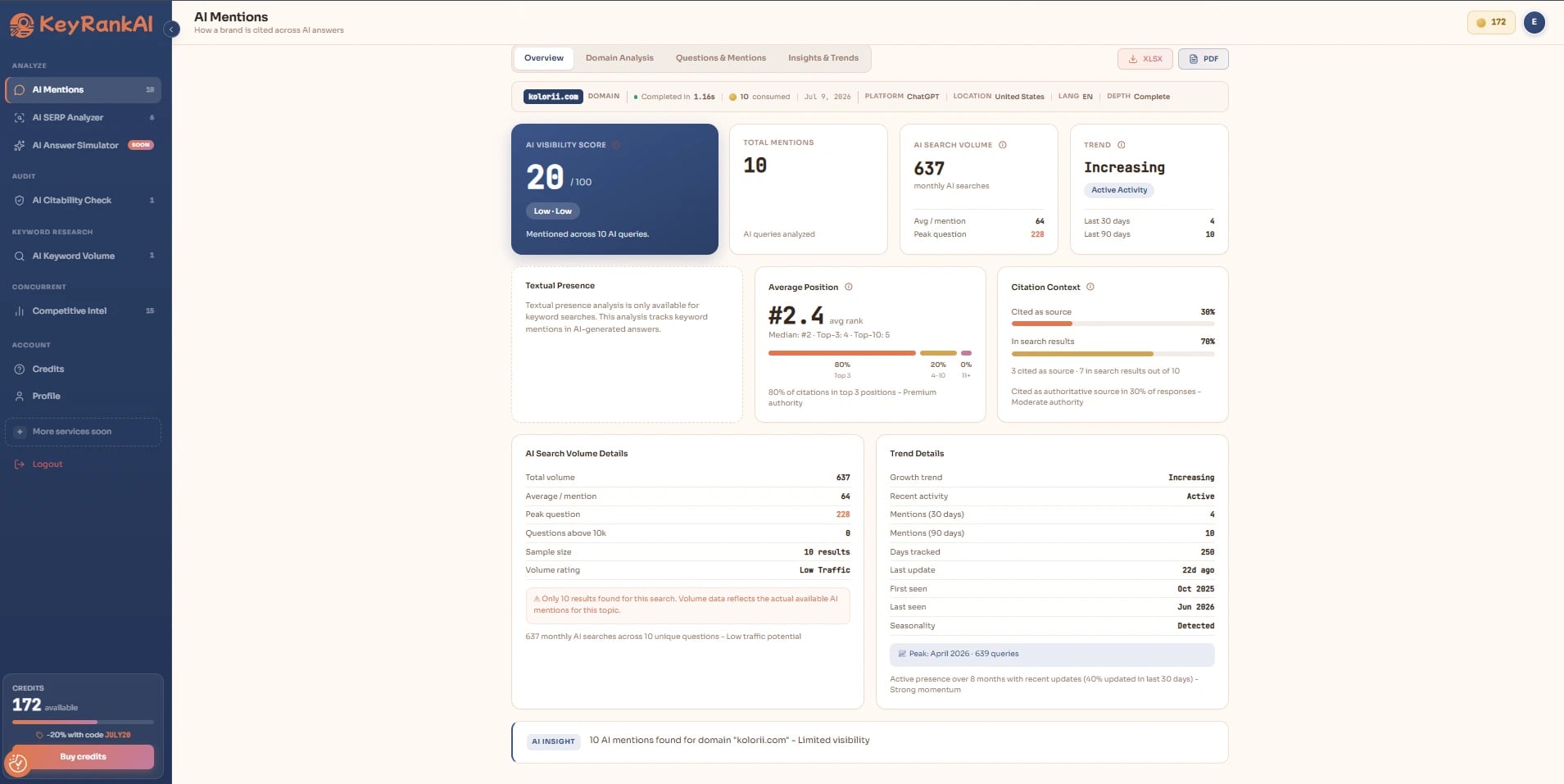
The gap between weak brand-name recognition and a strong citation position once actually cited is why AI visibility tracking means checking more than one angle, and checking it more than once, rather than running a single AI search visibility audit and calling it done. Here's what that process actually looks like, start to finish:
Why AI Search Visibility Changes Over Time
You may have come across a "30% rule" in AI visibility content, the claim that a fixed share of brands lose their AI-generated mentions between one check and the next. We looked into where that specific figure comes from and couldn't find a transparent methodology behind it, so we're not going to repeat it as fact.
What's real, and worth acting on, is that AI-generated answers aren't static. The same query can surface different mentions and sources over time as AI engines re-generate their answers. In the domain-mode test shown above, Kolorii's trend was marked "Increasing" over the last 90 days, a status based on comparing mention volume across recent time windows, not a single snapshot.
Even a thorough check only tells you where things stand today. Tracking that trend over weeks and months is what turns a one-time score into something you can actually act on.
AI Search Visibility Metrics and KPIs
A visibility check surfaces several numbers together, not just the headline score: total mentions, the search volume behind the topic, and trend direction. Here's how the score itself is actually built.
How the AI Visibility Score Is Calculated
The AI Visibility Score is Keyrankai's own scoring method, not an external or industry-standard metric. It's built from real signals collected when a brand or domain is checked: whether the brand is recognized as a distinct entity, how often it's mentioned by name in AI-generated answers, and whether the domain is cited as a source. These signals are weighted so that being cited as a source counts for more than being mentioned once in passing.
The result is a score out of 100, mapped to five plain-language tiers: Invisible / Very Low, Low, Moderate, High, and Dominant. Kolorii's brand-mode result from earlier in this guide (6/100, "Invisible, Very Low") and its domain-mode result (20/100, "Low") are both real outputs of this same scale, applied to two different search angles.
Because this is Keyrankai's own methodology and not a third-party or industry-validated standard, it's best read as a consistent way to track your own visibility over time and against competitors inside the platform, not as a universal AI ranking metric.
What to Look for in an AI Search Visibility Tracking Tool
Not every AI visibility tracking tool measures the same thing, so it helps to know what to check before picking one:
- Which AI engines it actually covers. Some tools only check one AI engine, others check several. If a tool doesn't say which engines it queries, that's worth asking directly.
- Mentions vs. citations, as separate data. As shown earlier in this guide, a brand-name check and a domain-citation check on the same site can produce very different results. A tool that only reports one of the two is giving you half the picture.
- Whether it tracks over time, not just once. A single check is a snapshot. Visibility in AI-generated answers can shift from one month to the next, so a tool that shows trend data is more useful than one that only returns a one-time score.
- Whether it shows competitive context. Knowing your own score is useful, but knowing where you stand against the other domains or brands being cited on the same topic is what turns a number into a decision.
Tracking Beyond a Single Score
A visibility score alone doesn't tell you where you stand relative to everyone else answering the same question, or whether you're being credited for the full breadth of a topic. In Keyrankai's AI Mentions tool, two views help close that gap.
Domain Rankings and Position
This is where AI citation tracking goes beyond a single score. When you check a topic, the domain view shows which websites AI engines are actually citing as sources, ranked by how often each one shows up. It also breaks down what share of citations each domain captures, so you can tell whether AI attention on that topic is concentrated among a handful of sites or spread across many, and where a given domain typically lands among the sources cited, not just whether it gets cited at all.
Knowing where you stand relative to everyone else, not just whether you're visible at all, is what actually shapes a strategy.
Question Clusters
A single topic is rarely asked the same way twice. "How to track AI visibility" and "how do you measure AI visibility" are different search queries with separate volume, but they're really the same underlying question. Grouping these variants together shows the true combined demand behind a topic instead of a fragmented, understated number, and makes it possible to check whether a brand is cited across the full cluster of related questions or only for one specific phrasing of it.
How to Improve Your AI Search Visibility
Improving AI search visibility isn't about keyword density, it's about making it easy for an AI system to recognize what you do, trust that it's accurate, and confidently cite you when the topic comes up.
Structure Content Around Clear Entities and Direct Answers
AI engines generate answers by pulling from content that states things plainly. A page that clearly defines what it is, what it offers, and answers a specific question in the first few sentences is easier to cite than a page that buries the answer in marketing language. Use headers to separate distinct topics and entities instead of blending several ideas into one long section, and lead with the answer before the explanation.
Keep Information Consistent Across Your Site
AI systems cross-reference what they find. If your homepage, about page, and product pages describe the same offering inconsistently, that ambiguity makes an AI system less confident about citing you as an authoritative source. Keeping names, descriptions, and claims consistent site-wide removes that friction.
Publish and Refresh Content Regularly
Recency matters for AI citation the same way it matters for classic search: engines have less reason to cite a page describing outdated information when a more recently updated source exists. Reviewing and updating older content, not just publishing new pages, keeps existing pages eligible to be cited going forward.
Competitive AI Search Visibility Analysis
Two real numbers from the same brand can look contradictory at first, and understanding why is part of reading AI visibility data correctly. In the domain view covered earlier, kolorii.com came out as the most cited domain among 13 sites answering general questions about the coloring-pages topic, a 21.7% citation share. Running the same brand through Keyrankai's Competitive Intelligence against two named competitors in the same space produced the opposite-looking result: last of three brands, 0% share of voice, in a market rated as moderately concentrated (58%).
Both numbers are accurate at the same time, because they answer different questions:
- Domain citation share measures how often a site gets cited as a source across broad, generic queries about a topic.
- Direct competitive comparison measures how a brand's specific mentions stack up against a hand-picked set of named competitors on the exact same queries.
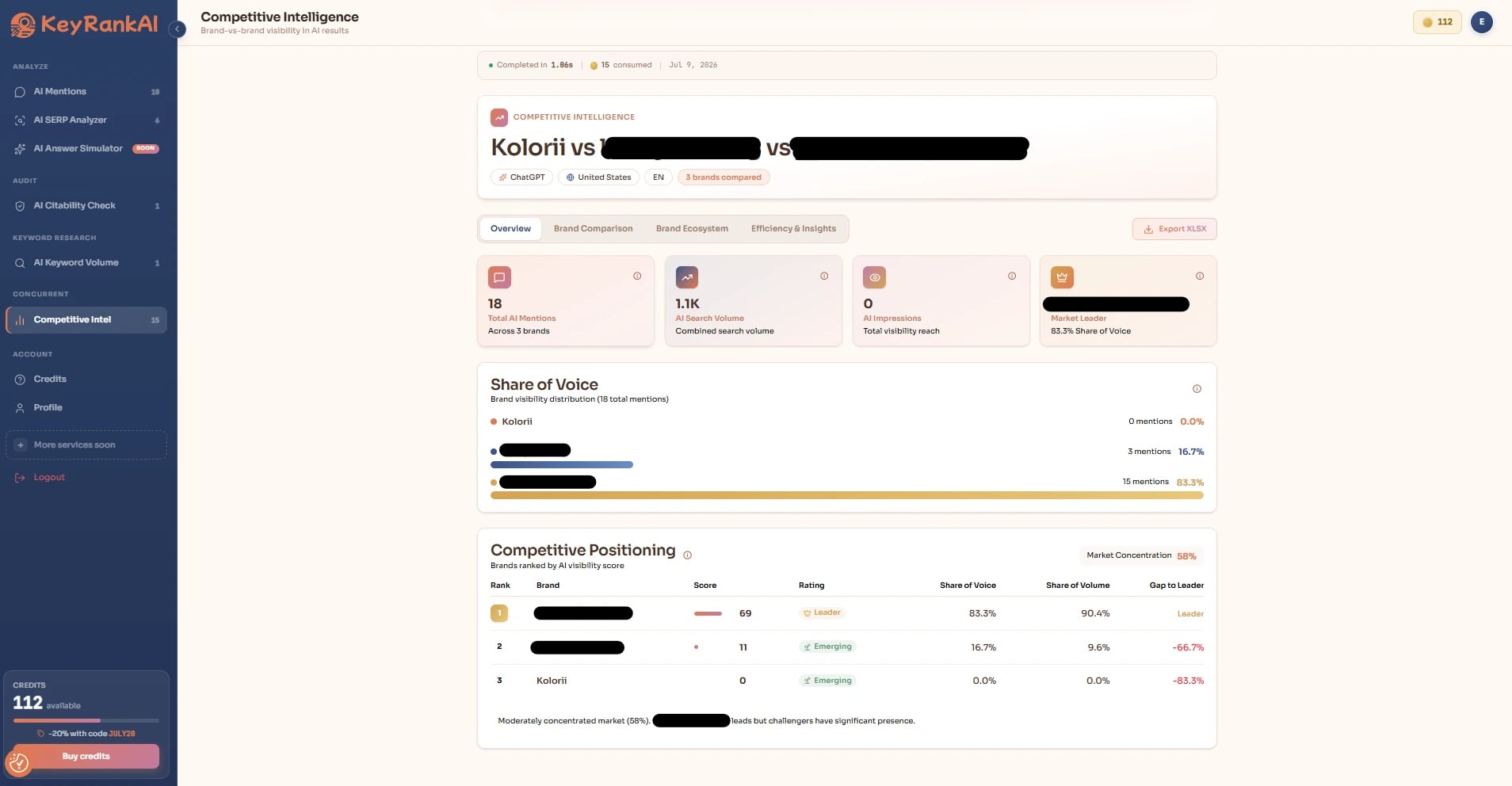
Which one matters more depends on the question you're actually asking: "is this domain a recognized source on this topic" or "is this brand ahead of these two specific rivals right now." Checking both is what avoids drawing the wrong conclusion from either one alone.
Conclusion
AI search visibility isn't one number you check once. As the tests throughout this guide showed, brand mentions and domain citations can tell two different stories about the same site, and a single score, however it's calculated, only reflects one moment in time.
Knowing what to check matters as much as checking it: which AI engines are actually covered, whether mentions and citations are reported separately, and whether you're looking at a snapshot or a trend. Run a real check on your own brand and domain, look at both angles, and build a habit of tracking AI visibility from there rather than treating it as a one-off audit.
Track Your AI Search Visibility
Check your brand and domain visibility across AI-generated answers, and track how it changes over time.
Start Tracking Visibility